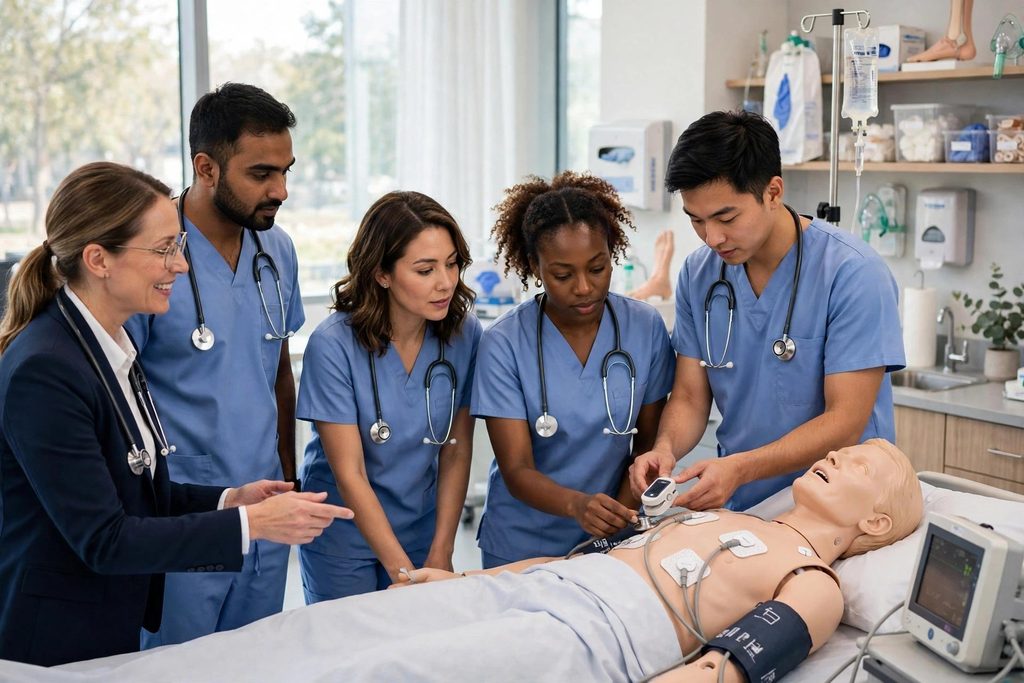
Nursing is one of the most trusted and essential professions in healthcare. Nurses are the people patients see first, rely on most, and remember longest and in a country investing heavily in hospitals, clinics and community care, qualified nurses are in constant demand.
If you are looking for a degree that combines science, compassion and a clear route into employment, a Bachelor of Science in Nursing is one of the strongest choices you can make.
This guide looks in detail at the BSN offered by the College of Pharmacy and Health Sciences at Ajman University: what the program covers, how its clinical training works, who can apply, and where it can take your career.
Why study nursing in the UAE?
Choosing where to study matters just as much as choosing what to study. Students searching for an ajman university uae program are usually looking for three things at once: a recognised qualification, real clinical experience, and a healthcare system with genuine opportunities after graduation.
The UAE offers all three. Its healthcare sector serves a large and diverse population, which means nursing students train in modern facilities and care for people from many different cultures and backgrounds.
That diversity shapes the degree itself. A good bachelor of nursing program in the UAE has to prepare graduates who can communicate across cultures, respect different beliefs about health and family, and still deliver care to the highest clinical standard.
Keep that in mind as you read through the program goals below — cultural sensitivity is not an optional extra in this degree; it is built into what graduates are expected to be able to do.
What the Bachelor of Science in Nursing involves
The Bachelor of Science in Nursing (BSN) at Ajman University is one of the newest programs offered by the College of Pharmacy and Health Sciences, and it is led by the Head of the Nursing Department, Dr. Deema Hamzeh Mazlouh Mahasneh.
The program totals 120 credit hours, completed over four years, and is organised into three main categories of study.
- General courses, which provide a foundation of knowledge across different disciplines and give students a well-rounded educational background.
- Nursing program courses, which form the core of the degree and focus on nursing theory, practice and the skills needed for competent nursing care.
- Clinical practice rotation courses, which place students in real healthcare settings under supervision.
This structure is deliberate. The general courses make you a better-rounded graduate, the core courses make you a knowledgeable nurse, and the rotations make you a capable one.
Many students comparing bsc nursing programs focus only on the classroom subjects, but the balance between theory and supervised practice is what employers notice first and it is the part of this degree that deserves the closest look.
What you will learn: the program goals
Ajman University sets out five clear outcomes for its BSN graduates. A graduate of the program will be competent to provide safe and effective nursing care across the patient’s lifespan, from children through to older adults.
They will provide culturally sensitive, ethical and person-centred nursing care that improves healthcare outcomes, and they will actively promote the health of individuals and their families, not simply treat illness when it appears.
Graduates are also expected to stay engaged in scholarship and lifelong learning, because nursing practice changes as evidence, technology and treatments develop. Finally, they learn to communicate therapeutically with patients and to collaborate effectively across professions with doctors, pharmacists, therapists and other specialists.
Taken together, these goals describe the modern nurse: clinically safe, ethically grounded, and able to work as part of a team. For anyone weighing up a bachelor’s degree in health sciences, that combination of caring and competence is exactly what a nursing degree should deliver.
Clinical practice: learning in real healthcare settings
Clinical practice rotation courses are described by the university as a vital component of the BSN, and it is easy to see why.
During these rotations, students work in hospitals, clinics and other healthcare facilities, applying the knowledge and skills they have learned in the classroom to actual patient care scenarios, always under supervision.
This is where a nursing career in UAE hospitals and clinics really begins. Rotations help students develop clinical competence and the ability to carry out nursing procedures safely and correctly alongside critical thinking, so they can assess a situation and respond appropriately rather than simply follow a routine.
They also build the interpersonal skills that classroom study cannot teach: speaking with anxious patients, supporting families, handing over information to colleagues, and staying calm and professional in busy clinical environments.
By the time they graduate, students have therefore already experienced the reality of nursing work. That experience matters when applying for nursing jobs, because employers want graduates who understand ward routines, patient safety and professional conduct from day one, not only in theory.
Admission requirements for the BSN
Admission to the nursing program at Ajman University is based on your high school results, your English level, and a personal interview. Under the UAE curriculum, the high school requirements are 60% in the Elite Track, 65% in the Advanced Track, or 70% in the General Track.
Equivalent qualifications from other educational systems are also accepted, so international applicants are not limited to the UAE curriculum.
For English, applicants need a minimum score of 80% in the English subject, or its equivalent in other curricula, a demanding but sensible standard for a profession where clear communication with patients and colleagues is a safety issue, not just an academic one.
Applicants must also pass a personal interview set by the College of Pharmacy and Health Sciences, demonstrating good conduct and maturity, and meet the university’s general admission requirements.
The interview is worth preparing for seriously. Nursing is a profession built on trust, and the college is looking for students who show the maturity and character the role demands, as well as the grades.
If you are still at school and aiming for this program, focus on your science subjects and your English, and think about how you would explain, in an interview, why you want to care for patients for a living.
Careers: where a BSN can take you
One reason nursing careers attract so many students is the variety of settings a single qualification can open up. Ajman University lists four career opportunities for its BSN graduates, and each one leads to a different working life.
- General nurses, working in hospitals and clinical settings and providing direct care to patients across different ages and conditions.
- Community health nurses, working outside the hospital walls to support the health of neighbourhoods and wider populations.
- School nurses, caring for children and young people in educational settings and promoting healthy habits early in life.
- Health educators, teaching individuals and communities how to prevent illness and manage their health with confidence.
These roles show why nursing jobs in UAE healthcare span far more than hospital wards. Community and school nursing suit graduates who want to work closely with families and prevention, while health education suits those who enjoy teaching and communication.
And because the degree emphasises lifelong learning, these first roles are a starting point: experienced nurses commonly go on to specialise, lead teams, teach, or study at postgraduate level as their nursing careers develop.
When you search for nursing jobs, you will see this breadth reflected in the range of employers recruiting from large hospitals to schools and community services.
Why choose Ajman University?
The university behind the degree matters to employers, so it is worth knowing the wider picture. Ajman University currently offers 46 programs — 26 undergraduate, 18 graduate and 2 doctoral — across 9 colleges, and all of its programs are accredited by the UAE Ministry of Higher Education and Scientific Research.
The BSN sits within the College of Pharmacy and Health Sciences, alongside other health programs, which gives nursing students a naturally interprofessional environment: the colleagues they will one day work with are studying in the same college.
Students and families comparing options for the best university in uae for health sciences should look beyond rankings alone.
Consider the program structure, the amount of supervised clinical practice, the admission standards, and whether the graduate outcomes match the job you actually want.
On those practical measures, this BSN makes a clear and honest case: 120 credit hours over four years, three well-defined strands of study, rotations in real facilities, and career routes that are named rather than vaguely promised.
Is the BSN at Ajman University right for you?
This degree will suit you if you are compassionate, calm under pressure, and genuinely interested in the science of health as well as the people behind the symptoms. It will suit you if you want a bachelor’s degree that leads directly to a defined profession, with skills that are needed in every country and every healthcare system.
And it will suit you if you are ready to learn in real clinical settings, not only in lectures because that is where this program puts much of its weight.
If that sounds like you, the next step is simple: review the admission requirements, prepare for the interview, and explore the program in full on the university’s website.
A Bachelor of Science in Nursing from Ajman University is more than a qualification. It is the start of a working life spent making a measurable difference to patients, families and communities and few degrees can honestly promise that.